

There’s a moment on every major construction project, somewhere between the planning table and the first shovel in the ground, when things start to fall apart. Conflicting blueprints. Systems that don’t talk to each other.
Engineers on three different continents working from four different versions of the same file. It’s not dramatic. It’s just quietly, expensively chaotic.That’s exactly the problem Ingebim was built to solve.
What Is Ingebim? Understanding the Company Behind the Name
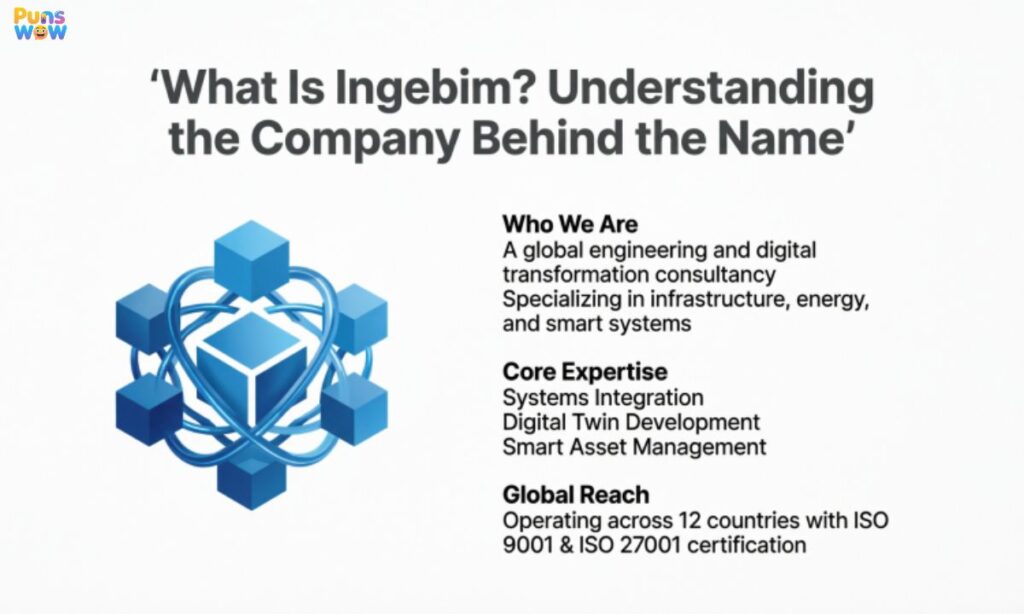
Ingebim is an international engineering consultancy that specialises in Building Information Modelling (BIM), digital infrastructure management, and construction project coordination. The name itself blends “ingeniería” (the Spanish and Portuguese word for engineering) with BIM, hinting at its roots and the core of what it does.
But calling it just a “BIM consultancy” undersells it a bit. Ingebim sits at the intersection of engineering expertise, data management, and digital transformation. It helps architects, project developers, civil engineers, and infrastructure owners turn messy, fragmented project data into unified, intelligent digital environments.
Think of it like this: if a major railway expansion is a symphony, Ingebim is the conductor making sure the string section (structural engineers), the brass (MEP contractors), and the percussion (civil teams) are all reading from the same score, in real time.
The Foundation: What Is BIM and Why Does It Matter
Before we go deeper into Ingebim’s work, it helps to understand what BIM actually is, because it’s often misunderstood.
Building Information Modelling isn’t just 3D design software. It’s a collaborative, data-rich process that connects architectural, structural, and engineering information into a single shared digital model. Unlike traditional CAD drawings (which are basically very sophisticated flat pictures), a BIM model contains live, intelligent data: material specifications, load calculations, fire safety ratings, MEP routing, lifecycle costs.
When it works well, BIM does several things simultaneously:
- It lets every stakeholder, from the structural engineer to the facilities manager, work on the same evolving model
- It detects design clashes before construction starts (not after, which is where costly rework happens)
- It creates a digital record of the asset that lives on long after the building is complete
- It enables simulation, testing, and scenario planning in a virtual environment
The global BIM market was valued at over $8 billion in 2023 and continues to expand rapidly, driven by government mandates in the UK, Europe, and Asia-Pacific requiring BIM adoption on public infrastructure projects. Ingebim is positioned right at the centre of that growth curve.
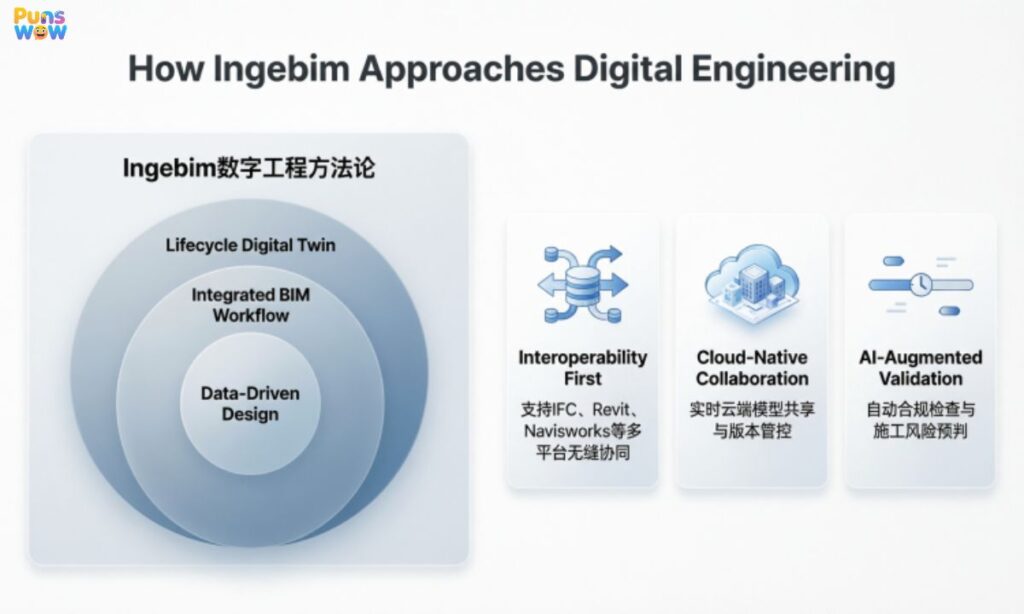
How Ingebim Approaches Digital Engineering
Advanced 3D Modelling and Clash Detection
Ingebim’s most fundamental service is high-fidelity BIM modelling. The team builds detailed digital representations of everything from underground metro tunnels to highway interchanges, models that contain not just geometry, but layered data about every structural and mechanical component within a project.
The real value emerges during clash detection. In large infrastructure projects, it’s almost inevitable that the ductwork planned by the mechanical team will try to occupy the same physical space as a structural beam designed by someone else working in a parallel model. Caught on-site, that kind of conflict means stopping work, rescheduling trades, and absorbing unexpected costs. Caught in a BIM model two months before breaking ground? It’s a 30-minute fix in the software.
Ingebim’s engineers run systematic clash detection reviews across federated models — essentially combining all the individual discipline models into one environment and stress-testing them against each other. It sounds technical because it is, but the output is straightforward: a cleaner, more reliable build.
Digital Twin Development
One of the more forward-looking parts of Ingebim’s portfolio is its work on digital twins. A digital twin is a living virtual replica of a physical asset, a bridge, a railway corridor, a tunnel network, that updates in near-real-time based on sensor data from the physical structure.
Imagine a highway authority being able to monitor stress loads on a bridge remotely, simulate the impact of a proposed widening project on traffic flow, and model different maintenance schedules to optimise cost, all without disrupting a single commuter. That’s the promise of digital twin technology, and Ingebim has been building this capability into major infrastructure projects across South America and Europe.
The practical applications are significant. Digital twins reduce reactive maintenance (fixing things after they break) in favour of predictive maintenance (fixing things before they fail). For long-lived assets like railways and metro systems, the lifecycle savings can be enormous.
Ingebim’s Services Across the Full Project Lifecycle
What distinguishes Ingebim from many BIM service providers is that it doesn’t just parachute in during the design phase and disappear. Its consultancy model spans the entire project lifecycle.
Pre-Design and Strategic Planning
In the earliest phases of a project, Ingebim works with clients to establish BIM Execution Plans (BEPs), the governance documents that define how project data will be created, shared, validated, and stored. Getting this right early prevents significant coordination problems downstream.
This stage also involves Level of Development (LOD) planning, which determines how detailed models need to be at each project milestone. An LOD 200 model (schematic-level) serves different purposes than an LOD 400 model (fabrication-ready). Ingebim helps clients understand what they actually need, and not over-engineer the modelling process.
Design Coordination and Multi-Discipline Integration
During the design phase, Ingebim acts as the BIM coordination hub. Different engineering disciplines deliver their models, and Ingebim integrates them into a Common Data Environment (CDE), a shared platform where everyone accesses the same current information.
This sounds simple until you’re managing a metro line expansion involving geotechnical engineers, tunnel designers, track specialists, station architects, electrical systems teams, and ventilation consultants, across three countries, two languages, and multiple time zones. The coordination complexity is real, and Ingebim’s track record in exactly these kinds of environments is part of what sets it apart.
Construction Phase Support
On-site, BIM models transition from planning tools to construction guides. Ingebim supports the use of 4D modelling (time-phased construction simulation) and 5D modelling (cost integration), giving project managers a dynamic view of both schedule and budget as construction progresses.
Contractors can pull current model data to verify measurements, check installation sequences, and flag any deviations from the design intent before small issues become expensive problems.
Asset Management and Operations
After the ribbon is cut and the project is handed over, the BIM model doesn’t retire, it becomes an operational asset. Ingebim structures its models for handover to facilities management teams, ensuring that maintenance schedules, warranty data, and technical specifications are embedded and accessible.
For a metro operator running 40 years of maintenance on a complex tunnel network, that structured digital record is genuinely invaluable.
Real Projects, Real Complexity: Ingebim in the Field
Santiago Metro Line 7 — Chile
One of the flagship projects associated with Ingebim is the expansion of Santiago’s metro system, specifically Line 7, a major underground corridor cutting through one of Latin America’s largest cities. The project involved complex sub-surface conditions, densely packed utility corridors, and coordination between Chilean engineering firms and international consultants.
Ingebim provided BIM coordination services that helped manage the extraordinary complexity of modelling station structures, tunnel segments, mechanical and electrical installations, and civil interfaces, all within a unified digital environment. The ability to visualise and interrogate the model before concrete was poured proved essential in a project where underground surprises carry very high remediation costs.
North Santiago Highway, Urban Infrastructure Upgrade
Highway modernisation in an active urban environment is one of the harder classes of infrastructure project. Traffic can’t simply be diverted for years while you rebuild. Ingebim’s involvement in the North Santiago Highway upgrade centred on using BIM to coordinate phased construction sequences, manage design interfaces between road, drainage, and structural elements, and maintain accurate as-built records throughout.
Swiss Railway Corridors, European Precision Engineering
In Europe, Ingebim has contributed to railway and tunnel projects in Switzerland, a country where the tolerance for engineering imprecision is essentially zero. The Etagnières Railway Corridor and the Montreux Twin-Tunnel feasibility study both required sophisticated digital modelling to analyse geological conditions, plan tunnel geometry, and coordinate structural design with operational requirements.
Swiss rail infrastructure has some of the highest technical standards in the world. The fact that Ingebim’s work is trusted in that environment says something about the quality of their output.
The Pros and Cons of BIM-Driven Engineering (Honest Assessment)
No technology or methodology is without trade-offs. Here’s an honest look at what BIM, and firms like Ingebim, deliver, and where the challenges lie.
Where BIM (and Ingebim) Genuinely Delivers
- Fewer costly surprises on-site. Clash detection and coordination reviews catch problems that would otherwise surface during construction, when fixing them costs 10x more.
- Better project visibility. Clients and project managers have a single, current source of truth rather than scattered spreadsheets and emailed PDFs.
- Improved handover quality. A well-structured BIM model handed over at completion is an asset that supports maintenance, upgrades, and future projects.
- Collaboration across distances. Distributed teams working in a Common Data Environment are genuinely more coordinated than teams sharing files by email.
- Long-term lifecycle value. Digital twins and asset models pay dividends over the decades of an asset’s operational life.
Where BIM Adoption Still Faces Headwinds
- Initial cost and setup complexity. Getting BIM properly implemented, especially on first-time projects, requires investment in software, training, and process change. Smaller firms sometimes struggle with this upfront burden.
- Data quality depends on input quality. BIM is only as good as the data that goes into it. If one discipline is delivering low-quality or inconsistently structured models, the coordination benefits erode.
- Change management challenges. Construction is a traditionally conservative industry. Getting every stakeholder on a complex project to actually use the CDE properly, rather than reverting to old habits, requires sustained effort.
- Interoperability still isn’t perfect. Different software platforms (Revit, ArchiCAD, Civil 3D, Bentley) don’t always exchange data cleanly. The IFC open standard helps, but real-world federated workflows still require careful management.
Practical Tips for Getting the Most From BIM Engineering
Whether you’re a project owner, developer, or engineering firm considering BIM on an upcoming infrastructure project, here are a few hard-won lessons from the industry:
1. Start the BIM Execution Plan early before design begins. A BEP written after modelling has started is like buying insurance after the accident. Get the governance framework agreed upfront.
2. Define your Level of Development requirements by phase. Not every model element needs to be LOD 400. Over-modelling wastes time and budget. Be specific about what level of detail you need and when.
3. Invest in Common Data Environment discipline. The CDE only works if everyone uses it consistently. Naming conventions, folder structures, and version control protocols need to be enforced, not just agreed and forgotten.
4. Don’t skip the clash detection reviews. It’s tempting to press on when the project schedule is tight. Don’t. An unresolved clash discovered in the model is cheap. The same clash discovered on-site is not.
5. Think about handover from day one. The asset owner who will manage this building or infrastructure for the next 30 years should have input into what the BIM model contains and how it’s structured for operations.
Ingebim’s Role in a Broader Industry Shift
The construction industry is, by most measures, one of the least digitally mature major industries in the global economy, historically lagging behind manufacturing, finance, and healthcare in adopting data-driven processes. BIM adoption is one of the most significant vectors of change in that transformation.
Ingebim’s contribution isn’t just technical. By delivering BIM coordination on landmark projects metro expansions, highway upgrades, railway tunnels, and by engaging with educational and professional institutions to promote BIM literacy, the firm is helping shift industry culture as well as project outcomes.
There’s also a sustainability dimension worth noting. Better-coordinated construction means less material waste, fewer do-overs, and structures that are designed with their full operational life in mind. Digital twins, in particular, enable the kind of condition-based maintenance that extends infrastructure lifespan and reduces the carbon cost of premature replacement.
Frequently Asked Questions
What exactly does Ingebim do
Ingebim is an international engineering consultancy focused on BIM services, digital modelling, and infrastructure project coordination. It helps large construction and infrastructure projects improve efficiency, reduce design conflicts, and manage complex multi-discipline coordination through digital engineering tools.
Is BIM the same as 3D modelling
Not quite. 3D modelling produces visual representations of geometry. BIM produces intelligent, data-rich digital models where every element contains structured information, materials, specifications, cost data, maintenance requirements. The 3D visualisation is part of BIM, but the data management layer is what makes it genuinely powerful.
What types of projects benefit most from Ingebim’s services
Large, complex infrastructure projects, metro systems, highways, railways, tunnels, airports, where multiple engineering disciplines need to work in coordination, and where design errors caught late carry significant cost and schedule penalties.
How does Ingebim compare to a typical structural engineering firm
Ingebim isn’t a structural designer, it’s a digital engineering and BIM coordination specialist. It works alongside structural, civil, and MEP engineers to integrate their work into a coherent digital environment, detect conflicts, and manage the information flow across a project.
What is a digital twin and does Ingebim build them
A digital twin is a virtual replica of a physical asset that reflects its real-world condition, often updated by sensor data. Yes, Ingebim develops digital twin capabilities as part of its infrastructure services, with applications in asset monitoring, maintenance planning, and scenario simulation.
Does Ingebim work internationally
Yes. Its portfolio includes projects in Chile, Switzerland, and other international markets, and the firm collaborates with engineering organisations across multiple regions.
Conclusion
Infrastructure isn’t getting simpler. The projects being commissioned today, metro expansions in rapidly urbanising cities, cross-border rail corridors, complex tunnel networks, are bigger, more technically demanding, and more interdependent than anything the industry has built before.In that environment, the old model of siloed engineering disciplines exchanging PDF drawings by email simply doesn’t cut it anymore. The coordination overhead alone becomes a project risk.
Ingebim represents a clear-eyed answer to that problem. Not by replacing engineers or automating design, but by creating the digital infrastructure that lets engineering expertise be applied more precisely, more collaboratively, and more effectively. The BIM model isn’t the building, but in the hands of a firm that knows how to build and manage it properly, it’s the thing that makes the building possible.For developers, project owners, and engineering teams navigating the growing complexity of infrastructure delivery, understanding what firms like Ingebim actually do, and how to work with them effectively, is becoming less of a nice-to-have and more of a competitive necessity.

Callum is a creative pun writer with 4 years of experience in humorous blog content. He specializes in clever wordplay and viral puns, and now contributes his expertise to creating fun, engaging content at PunsWow.com.